
Traditional clinical trial oversight often relied heavily on routine site visits and extensive Source Data Verification (SDV — comparison of reported trial data against original source records). In contrast, Risk-Based Quality Management (RBQM) shifts the emphasis toward identifying what is critical to study quality and directing oversight toward areas where meaningful risks exist.
Quality by Design (QbD — proactively building quality into the design of a clinical study) starts before monitoring begins. In practice, the objective is to identify the factors that are critical to study quality during planning and design, rather than relying only on detecting problems later.
Therefore, risk-based approaches focus attention on processes, data and activities that have the greatest potential impact on participant protection and the reliability of trial results.
In addition, oversight should reflect the significance of the identified risk. Higher-priority risks may require stronger controls, more frequent review or targeted action, while lower-priority risks may justify lighter oversight.
Risk-Based Monitoring (RBM — a monitoring strategy that adapts monitoring activities according to identified risks) and Risk-Based Quality Management (RBQM) are closely related, but they are not interchangeable. While RBM primarily concerns how clinical trial monitoring is planned and performed based on risk, RBQM takes a broader view across the clinical trial quality lifecycle.
Simply put: RBM helps determine how and where to monitor. RBQM, however, considers how quality-related risks are identified, assessed, managed, monitored and reviewed across the study.
Effective RBQM is not about adding more controls. Instead, it is about understanding what matters most, identifying the risks to those areas and creating a proportionate way to detect and respond to change throughout the clinical trial.
First, QbD (Quality by Design — building quality considerations into study design from the beginning) helps teams identify the factors most important to the study before operational complexity is introduced.
In addition, Critical-to-Quality (CtQ — factors fundamental to participant protection and reliable study results) helps teams distinguish what truly matters from activities with lower impact on overall trial quality.
Next, potential risks to CtQ factors are identified and evaluated according to characteristics such as their potential impact, likelihood and detectability.
As a result, controls and monitoring activities should reflect the significance of the risk rather than applying the same level of oversight everywhere.
At the same time, Centralized Monitoring (remote, systematic evaluation of accumulated study data and conduct across sites) helps teams identify patterns, inconsistencies, omissions and potential anomalies across the study.
Finally, RBQM does not end when the initial risk assessment is approved. Instead, risks, signals, controls and assumptions should be reviewed as the study evolves and new information becomes available.
RBQM works as a continuous cycle rather than a one-time risk assessment. First, study teams identify what matters and understand the associated risks. They then establish appropriate controls and continue reviewing signals as the study evolves.
First, define the processes, data, endpoints and activities essential to participant protection and reliable results.
Next, determine what could meaningfully affect those Critical-to-Quality factors.
Then, evaluate impact, likelihood and detectability to determine where additional attention may be needed.
Based on that assessment, establish appropriate controls, indicators, thresholds, monitoring activities and escalation processes.
During study conduct, review operational and clinical data to identify emerging trends, outliers and changes in risk.
When meaningful signals emerge, understand their significance and implement proportionate action where necessary.
Finally, reassess risks, controls and assumptions as the study and available information evolve.
RBQM is therefore a continuous feedback loop: identify → assess → control → monitor → act → review.
Not every risk in a clinical trial requires the same level of attention. Effective RBQM distinguishes between risks that could meaningfully affect participant safety, trial integrity or the reliability of results and risks whose potential impact is limited.
Therefore, risk assessment provides the basis for prioritization. Risks with greater potential impact may require specific controls, closer monitoring, defined thresholds or escalation pathways. Other risks may require routine oversight only. A lower-priority risk is not necessarily an ignored risk; the level of attention should reflect its significance within the context of the study.
In addition, risk-based decisions should be understandable and traceable. Teams should be able to explain what risk was identified, how it was evaluated, what decision was made and why a particular action — or no additional action — was considered appropriate. Documenting this rationale helps preserve context as the study evolves and supports later review of quality-management decisions.
The key principle: RBQM is not simply about detecting more risks. It is about making proportionate, evidence-informed decisions about the risks that matter most — and being able to explain those decisions.
However, clinical trial risks are not static. Their relevance and significance can change as the study progresses, new participants are enrolled, more data becomes available and operational conditions evolve.
A risk that requires significant attention during one phase of a trial may become less relevant later. For example, participant enrollment may represent a significant operational risk during study start-up and recruitment but become far less relevant once enrollment is complete. Conversely, risks associated with accumulated data quality, protocol compliance, safety signals or study close-out may become increasingly important later in the trial.
Therefore, RBQM requires ongoing review rather than a single risk assessment performed at study start. Teams should consider whether existing risks remain relevant, whether their significance has changed, whether new risks have emerged and whether monitoring priorities or controls should be adjusted.
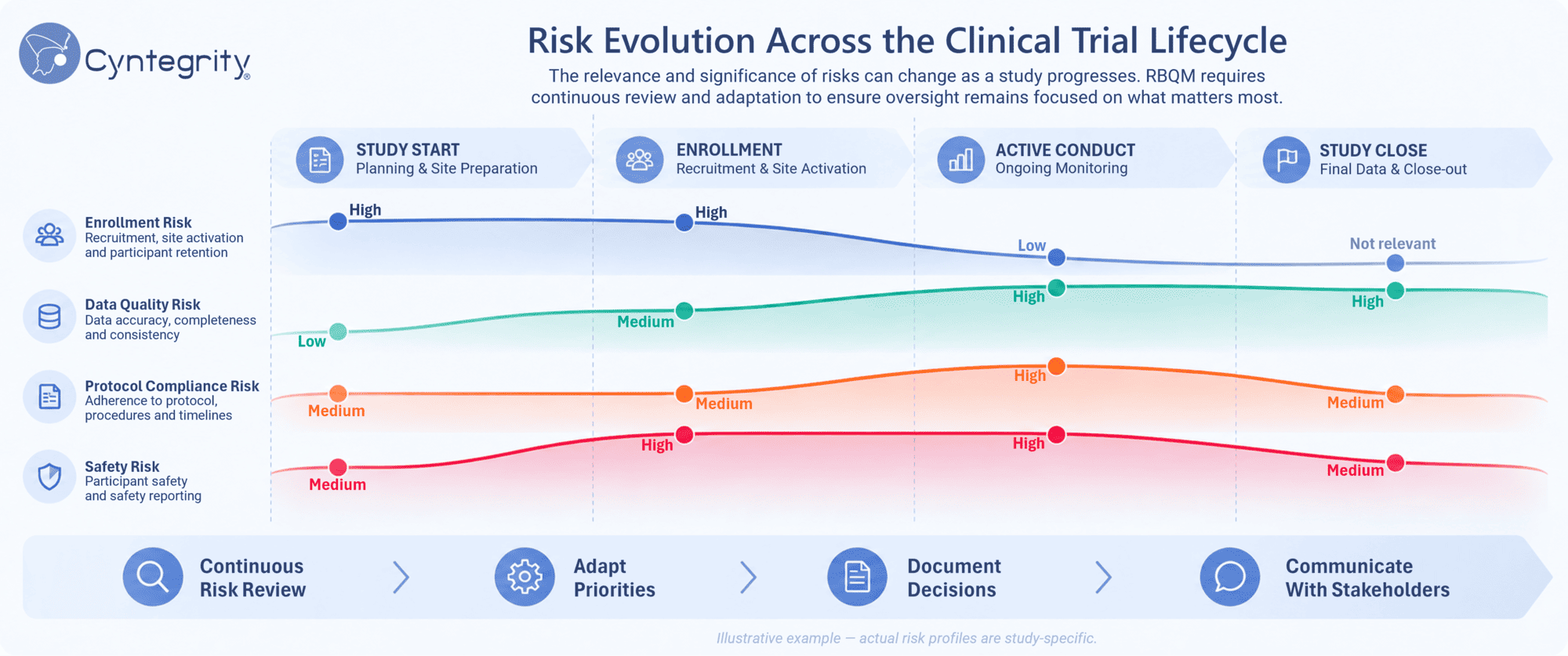
The key principle: risk-based oversight should evolve with the study. The risks receiving the most attention today may not be the risks requiring the most attention tomorrow.
Importantly, RBQM is not the responsibility of a single person, function or system. Effective risk-based quality management is a multi-stakeholder activity that depends on different functions contributing their expertise to identify, interpret, communicate and respond to study risks.
For example, depending on the study and the risk being evaluated, RBQM may involve Clinical Operations, Quality, Data Management, Medical and Safety teams, Central Monitoring, Biostatistics, study leadership, investigators and service providers. Different stakeholders contribute different context to the same risk-based decision.
Cross-functional expertise and accountability provide the clinical, operational, statistical and quality context needed to interpret risk.
Defined processes create consistency in how risks are identified, assessed, monitored, communicated, escalated, reviewed and reported.
Integrated data, analytics and centralized oversight help teams identify patterns, surface meaningful signals and support timely risk review.
People provide context. Process provides consistency. Technology provides visibility. Effective RBQM requires all three working together.
In practice, RBQM relies on meaningful indicators to help teams understand whether trial conduct remains within expected parameters and where additional review may be required.
A KRI (Key Risk Indicator — a metric used to monitor changes in risk exposure) provides a measurable signal related to an identified area of risk.
In comparison, a QTL (Quality Tolerance Limit — a predefined limit used to identify important deviations from acceptable study-level quality) focuses on parameters important to participant protection or the reliability of trial results.
The key difference: KRIs help teams monitor risk signals during study conduct, while QTLs focus attention on important deviations that may affect overall study quality.
RBQM should not be treated as an activity that begins only after the first participant is enrolled. Instead, risk-based quality thinking can support decisions throughout the entire lifecycle of a clinical trial.
First, identify Critical-to-Quality factors, study-specific risks and the initial quality-management strategy.
Next, translate risks into monitoring plans, KRIs, QTLs, controls, responsibilities and escalation pathways.
As the study begins, review early signals and determine whether assumptions made during planning remain valid.
During study conduct, use centralized and other monitoring activities to identify trends, outliers and emerging risks.
When signals emerge, interpret them in context and determine whether further investigation or action is required.
Where necessary, document decisions and implement proportionate actions to address identified issues and reduce risk.
Finally, evaluate significant quality events, document outcomes and capture lessons that can improve future studies.
Modern Good Clinical Practice (GCP — internationally recognized ethical and scientific quality standards for clinical trials) increasingly emphasizes quality management that is proportionate to risk. Therefore, risk-based thinking has become an important part of modern clinical trial quality management.
ICH E8(R1) (General Considerations for Clinical Studies) emphasizes designing quality into clinical studies and identifying Critical-to-Quality factors during study design. In particular, it supports approaches that focus attention on factors important to participant protection and reliable results.
In addition, ICH E6(R3) (Good Clinical Practice) reinforces a proportionate, risk-based approach to quality management throughout the trial process, connecting quality management with risk identification, evaluation, control, communication and ongoing review.
Ultimately, the objective is not to eliminate every possible risk. Instead, it is to understand which risks could meaningfully affect participant protection or the reliability of trial results, establish appropriate controls and maintain oversight as the study evolves.
When implemented effectively, RBQM can therefore help clinical trial teams create more focused, informed and proportionate quality oversight. Importantly, its purpose is not simply to reduce monitoring, but to direct attention toward the factors most important to trial quality.
First, RBQM helps concentrate attention on the processes and data that matter most rather than treating every issue as equally important.
In addition, centralized data review and ongoing monitoring can make emerging patterns and potential quality issues visible earlier.
As a result, structured risk assessment and signal review provide a clearer basis for determining when investigation or action is required.
Therefore, monitoring and quality resources can be directed toward areas where the potential impact on study quality is greatest.
At the same time, RBQM can create a shared framework for clinical operations, data management, medical monitoring, quality, statistics and other stakeholders to discuss risk.
Finally, teams can use risk reviews and documented decisions to improve the current study and inform future trial design and oversight.
The principles behind RBQM are relatively straightforward. However, applying them consistently across complex clinical trials, teams, systems and data sources is much harder.
For example, more KRIs do not automatically create better oversight. Poorly selected indicators can create noise and distract teams from meaningful risk.
Similarly, thresholds without clinical or operational context can produce excessive alerts or fail to identify meaningful change.
In addition, a signal is not automatically a problem. Teams need enough context to distinguish normal variation from meaningful risk.
Without a structured and consistently applied framework, different teams may evaluate similar risks differently.
Moreover, when risk assessments, monitoring data, signals, actions and documentation live in separate systems or spreadsheets, teams can lose the complete picture.
Finally, technology can surface information, but teams still need clear responsibilities, review processes, escalation paths and decision-making structures.
Ultimately, effective RBQM depends on more than metrics or software. It requires the combination of methodology, technology, governance and human expertise.